Mechanical Engineering At Gonzaga
It is the goal of the Department of Mechanical Engineering to develop men and women who are both competent engineers and educated, responsible human beings. The student's evolution into an educated and responsible human being is affected by course work from both the liberal arts and the profession. |
![]() |
Conversely, a graduate who is unable to communicate effectively, or incapable of making correct logical inferences, or who behaves unethically is deficient both as an educated human being and as a competent professional. Thus, the two aspects of this goal are interwoven, being a single, integrated fabric having many threads, contributed by many curricula. This synthesis is articulated in the following four program educational objectives:
1. Develop engineered solutions that are well-conceived and carefully implemented to meet public and private sector needs.
2. Contribute effectively to organizations as leaders and/or team members,
3. Foster personal and organizational success in a dynamic, globalized professional environment,
4. Improve society by applying Jesuit, humanistic values to their professional and civic responsibilities.
These four Objectives encompass the broad areas in which we believe our graduates will contribute to society in their careers and professions.
|
|
The first three objectives represent the technical needs of an engineer: Competence in math, science, engineering analysis, experimentation, and design. |
The fourth objective represents the professional needs of an engineer, such as the ability to communicate both orally and in writing, awareness of the larger world, and a moral undergirding. Attainment of these program objectives prepares students to enter practice as an engineer, which directly aligns with Gonzaga’s mission of “...our students… should also attain more specialized competence in at least one discipline or profession.” Furthermore, attainment of these objectives “will enable our graduates to enter creatively, intelligently and with deep moral conviction into a variety of endeavors, and provide leadership to… the professions, business, and public service,” thus fulfilling the overall mission of Gonzaga.
Diversity of opportunity and professional breadth are hallmarks of Mechanical Engineering. This translates into a need for a thorough grounding in a variety of mathematical, scientific, and engineering fundamentals. Thus, the program prepares students in the areas of mathematics, chemistry, physics, mechanics, thermodynamics, fluid mechanics, heat transfer, materials, manufacturing, design, control theory, experimentation, and economics.
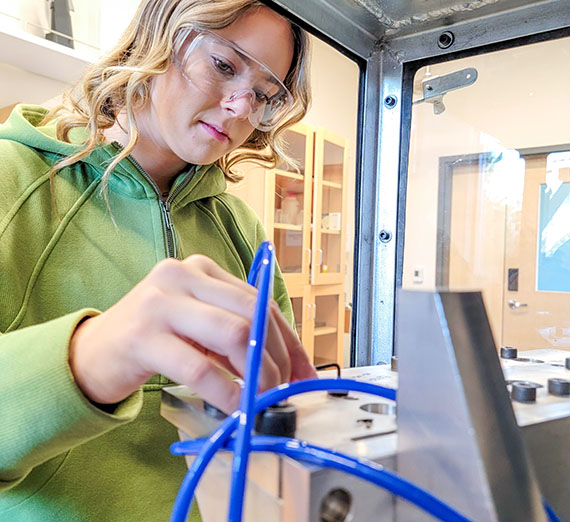
These fundamentals are enhanced by exposure to important engineering tools such as computer applications tools and equipment, instruments, and software typically found in manufacturing and laboratory environments. |
![]() |
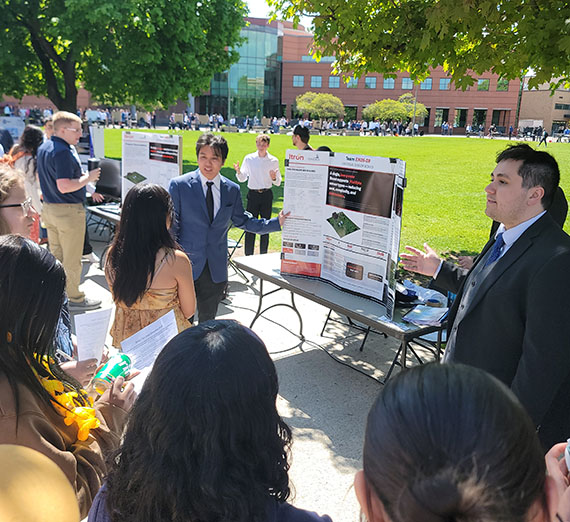
Teamwork is an essential aspect of modern practice and the program thus gives considerable attention to building personal communication skills through team design projects, reports, and presentations, as well as through communication skills courses in the University Core Curriculum. Design is also an integral part of the program and students engage in design activities beginning in their sophomore year and continuing throughout their studies. The design curriculum culminates in a two-semester major design experience that includes the solution of real industrial problems by student design teams led jointly by faculty and industry engineers.